On September 3, 1866, the Sri Lanka Police was formally established under constitutional provisions by its first Inspector General of Police, G. W. R. Campbell, a British national. Prior to this formal establishment, the foundations of policing in the country evolved gradually. During the Dutch colonial rule in Sri Lanka, a district officer was appointed to administer the Colombo area. This was followed by the appointment of a police constable in 1806, and in 1815, the designation “police peon” was officially changed to “police constable,” marking a progressive development in law enforcement duties.
In 1832, the Police Ordinance No. 03 of 1832 was enacted by a committee appointed by Sir Robert Wilmot Horton. At that time, approximately 1,430 officers served as a police force under the leadership of a Superintendent of Police.
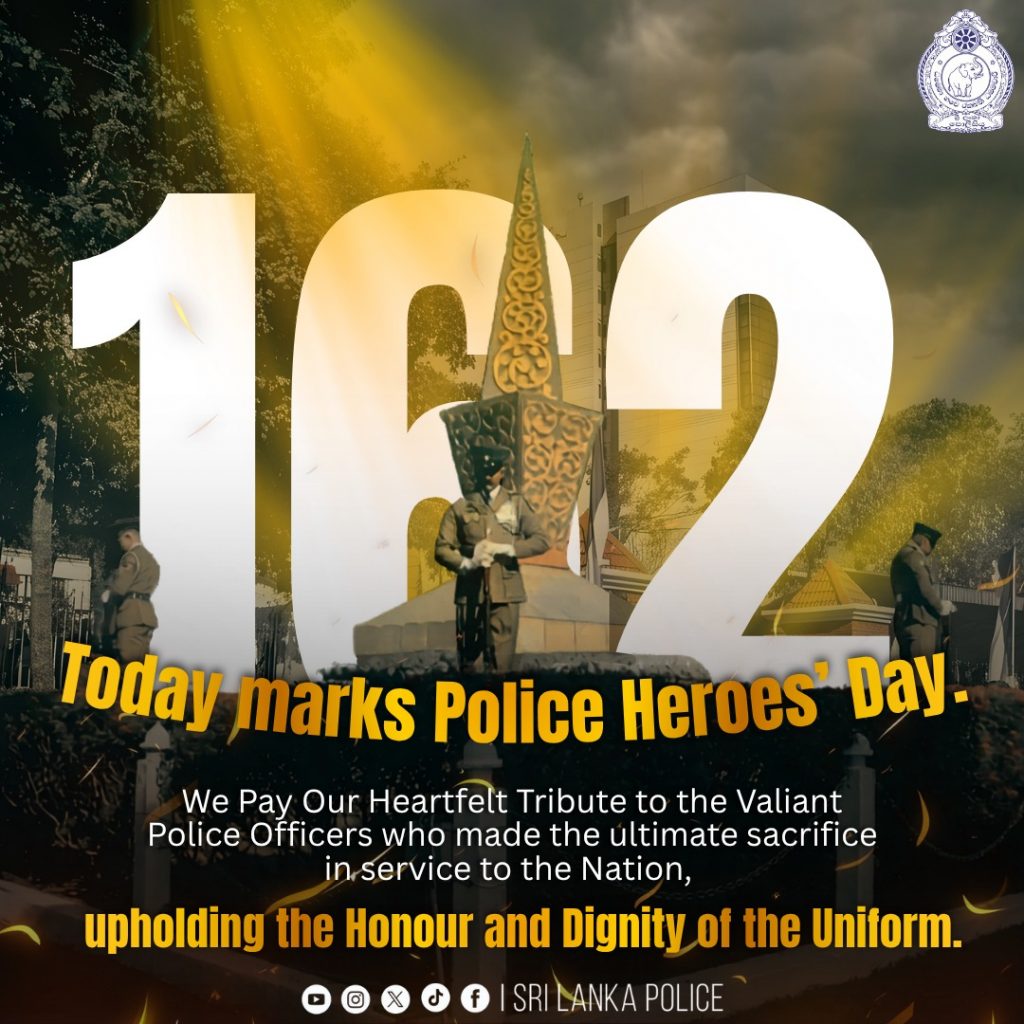
The Sri Lanka Police commemorates Police Heroes’ Day annually on March 21st. This date marks the sacrifice of Police Constable Sahan, who, while carrying out orders issued by Kegalle District Attorney E. R. Saunders to apprehend Utuwankanda Saradiel—a figure resisting colonial rule—lost his life during a confrontation.
One of the earliest memorials dedicated to a fallen police officer in Sri Lanka is located at the Utuwankanda Junction, where a monument stands in tribute to an officer who died in the line of duty.
Accordingly, today (21), we solemnly observe the 162nd Police Heroes’ Day, paying tribute to the courageous officers who made the ultimate sacrifice in safeguarding the nation. This includes those who laid down their lives during the nearly three-decade-long Sri Lankan Civil War, as well as those who perished in the line of duty while confronting threats to public peace, law, and national security.