

Police Health and Welfare Scheme Expanded to Enhance Benefits for Police Officers
The Police Health and Welfare Scheme, administered by the Sri Lanka Police, is a dedicated fund established to provide financial assistance for the health and welfare of police officers.
The scheme offers financial relief to officers for maintaining good health, as well as for the treatment of various illnesses, surgical procedures, and funeral expenses.
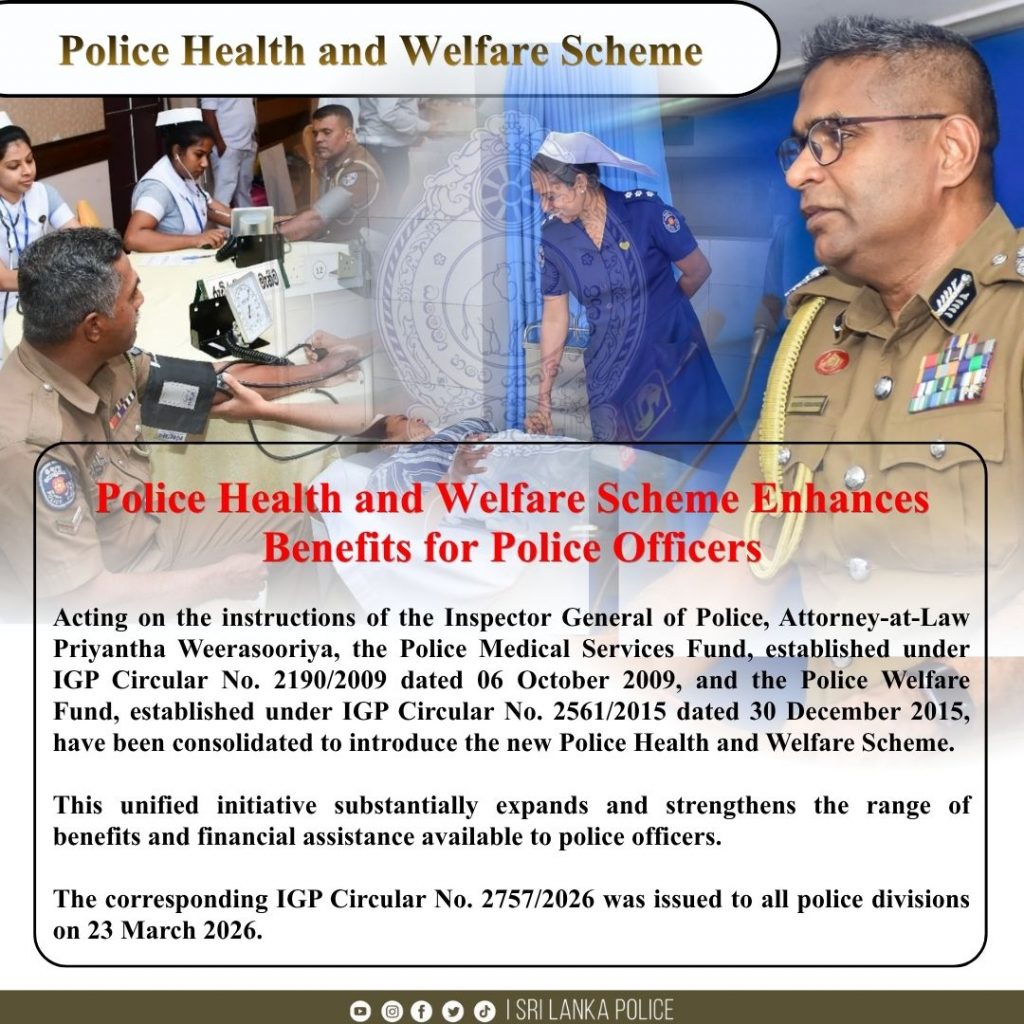
On the instructions of Inspector General of Police, Attorney-at-Law Mr. Priyantha Weerasooriya, this enhanced scheme was introduced to broaden the scope and benefits of the Police Health and Welfare Scheme under IGP Circular No. 2757/2023, which was created by amalgamating the former Police Medical Services Fund and the Police Welfare Fund.
The corresponding IGP Circular No. 2757/2026 (1) was issued to all police divisions on 23 March 2026.
Under the scheme, a contribution of Rs. 150 is deducted monthly from the salary of each participating police officer. In addition, with the approval of the Inspector General of Police, more than Rs. 10 million is credited each month to the fund from the Police Prize Fund through the Police Entertainment Fund.
Major Medical Assistance
If a serving police officer is diagnosed with a critical illness and undergoes life-saving surgery involving the heart, brain, cancer, kidneys, bone marrow, or liver, the scheme will reimburse expenses for surgery, medicines, and vaccines incurred during the period of service, up to a maximum of Rs. 2,000,000 (Rs. 20 lakhs). This represents the highest benefit available under the scheme.
Officers may first obtain assistance through the National Insurance Trust Fund Gold Scheme, the President’s Fund, or any other insurance or welfare scheme. If these sources do not fully cover the treatment costs, the outstanding balance may be reimbursed through the Police Health and Welfare Scheme, subject to the maximum limit of Rs. 2,000,000.
Even if the same surgery is required again, reimbursement may be granted under the scheme, provided the total assistance does not exceed Rs. 2,000,000.
Assistance for Other Critical Surgeries
A maximum of Rs. 500,000 (Rs. 5 lakhs) is payable for each of the following emergency or specialized procedures:
* Lung surgery
* Uterine surgery
* RF ablation
* Primary renal artery treatment
* Pancreatitis treatment
* Fulminant Hepatitis (FH)
* Multiple Sclerosis (MS)
* Spine surgery
* Organ transplantation
If treatment costs are only partially covered by the National Insurance Trust Fund Gold Scheme, the President’s Fund, or any other insurance or welfare scheme, the remaining balance may be reimbursed up to Rs. 500,000.
If the same surgery is required again, officers may continue to claim benefits, provided the total reimbursement does not exceed Rs. 500,000.
Additional Benefits
The expanded scheme also provides the following benefits:
Paralytic conditions: Rs. 100,000 (one lakh).
Essential orthopedic surgeries: Up to Rs. 250,000 (two hundred and fifty thousand), payable on two occasions, for knee, hip, hand, or foot bone graft surgeries that cannot be performed at the Police Hospital and involve lengthy waiting periods at government hospitals.
Hearing aids and artificial limbs: Reimbursement up to Rs. 50,000 for officers in active service, based on medical recommendation.
Diagnostic tests: Reimbursement up to Rs. 20,000 for MRI, angiogram, CT scan, PET scan, or echocardiogram conducted at private laboratories while receiving inpatient treatment at a government or Police Hospital, limited to three claims.
Dialysis treatment:Reimbursement for dialysis expenses incurred at government-approved private hospitals, limited to three claims, up to a maximum of Rs. 2,000,000.
Medication for non-surgical treatment:If prescribed medicines are unavailable at government hospitals, the Police Hospital will provide the medication for up to three years, subject to a maximum of Rs. 25,000 per month, based on medical advice.
Eyeglasses: Reimbursement up to Rs. 15,000 for officers over 40 years of age with impaired vision.
Strengthening the Welfare of Police Officers
Through the expansion of the Police Health and Welfare Scheme, police officers are now entitled to a comprehensive range of medical and welfare benefits, ensuring greater financial security and improved access to essential healthcare services throughout their careers.
CONTACT US
- Police Headquarters, Colombo 02, Sri Lanka.
- (+94) 11 2421111
- (+94) 11-2440584

