

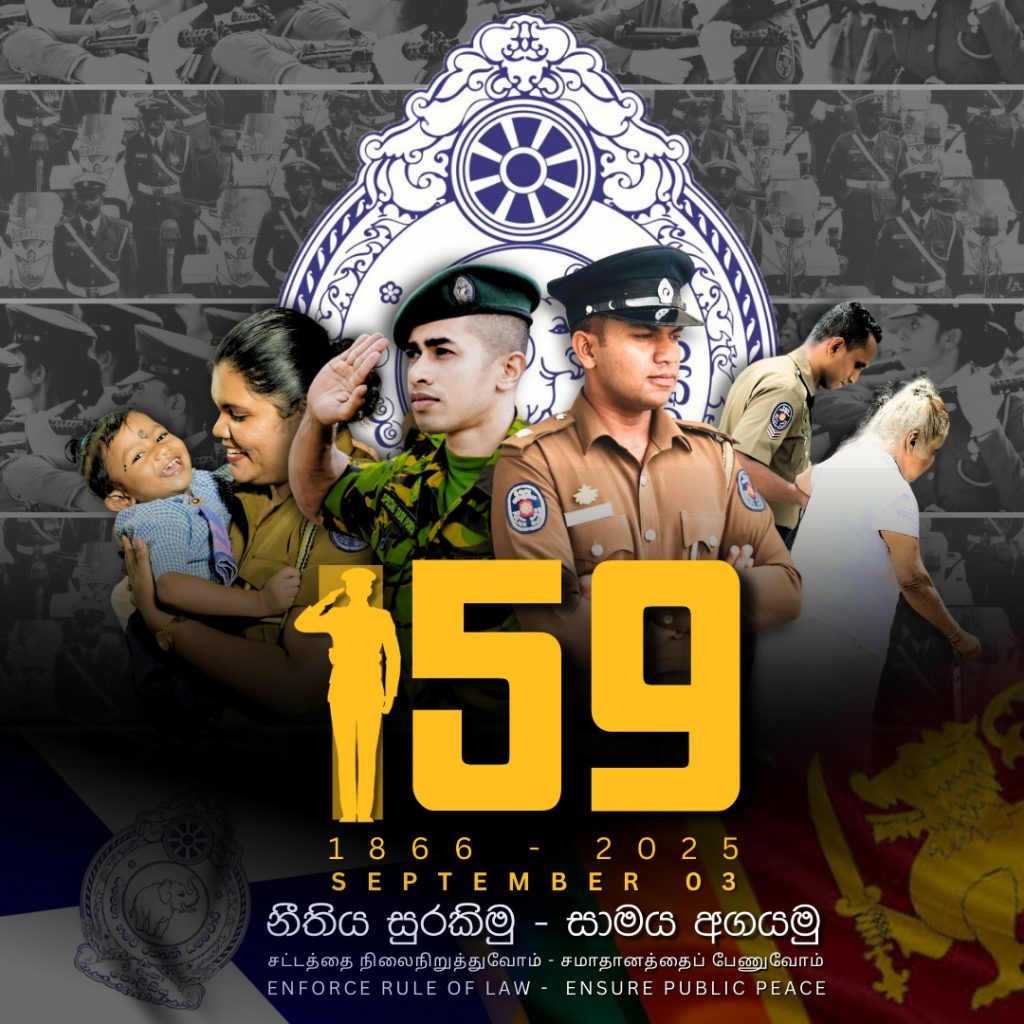
“RULE OF LAW – ENSURE PUBLIC PEACE” 159th Anniversary of Sri Lanka Police
The 159th Anniversary of the Sri Lanka Police, an institution with a history spanning over a century and a half, will be celebrated on 03rd September 2025.
03rd September 1866, the day Mr. G. W. R. Campbell was appointed as the first Inspector General of Police, is recognised as the foundation day of the Sri Lanka Police.
Accordingly, having to celebrate 159th Police Day within a fortnight from Mr. Priyantha Weerasooriya’s (Attorney-at-law) assuming duties as the 37th Inspector General of Police marks a significant milestone, since the day of assumption of duties in the office of Inspector General of Police is commemorated as the Police Day.
Historical evidence substantiates the fact that there had been duties similar to the police duties even within the period when the system of monarchy prevailed in Sri Lanka.
When tracing the history of police, facts emerge on how the police duty marked its inception during a time when foreign nationals invaded this country which was ruled under a system of monarchy.
Subsequent to the Dutch occupation of the coastal areas in 1602, the Colombo Municipal Council approved a proposal in 1650 to deploy guards for the protection of the city at night. Accordingly, four soldiers were employed to conduct night patrols in the city, which can be considered the initial duty of the Sri Lanka Police.
On 16th February 1796, the Dutch surrendered to the British, and from then onwards, the British Army was responsible for maintaining law and order in the country. An additional financial burden regarding the supervision of the police fell heavily on the government. As a result, Governor Frederick North, with the consent of the Chief Justice, entrusted the responsibility of overseeing the Police to the magistrates and Police judges. A law was passed for the first time with regard to the Sri Lanka Police after a short period of time from the occupation of Sri Lanka by the British. Afterwards, regulations were enacted in 1806 to appoint a Police Officer or a type of headman named Village Police Vidane for each village. They were held accountable to the Government Agent of the respective district and were also entrusted with the responsibility of maintaining order and investigation of crimes in the relevant villages under their purview.
Since the title of the head of the Police Force was changed from Chief Superintendent of Police to Inspector General of Police with the amendment of Police Ordinance No. 16 of 1865, the statutory establishment of present police service occurred on 03rd September 1866.
The Governor, Frederick North, who was looking for a dynamic person to reorganize the police in the Island, conducted some observations into such affairs, with the intention of drawing inspirations from the police duties in India. The Governor of Bombay recommended Mr. G. W. R. Campbell, who was in charge of the “Rathnagiri Rangers” of the Bombay Police, to shoulder this onerous responsibility. Mr. Campbell was selected by the Governor and he assumed duties as the Chief Superintendent of Police on the 03rd of September 1866.
By 1843, the existing Police Ordinance was repealed, granting the Governor the authority to establish Police Stations at any location on the Island. In 1845, the position, Inspector of Police was introduced, increasing the number of Police officers, and the rank, Police Constable was introduced, replacing the rank of Police Peon.
In 1870, with the objective of unravelling the increasing commercial crimes, baffling murders, and mysteries, deployment of Police officers in civil attire was initiated.
Subsequently, the Criminal Investigation Department was inaugurated by Major Knolis who was appointed the Inspector General of Police in 1891 and the first Officer in Charge of the said establishment was Inspector of Police Mr. Kothalawala.
Sir Richard Aluvihare, commenced duties on 01st June 1947, as the first Sri Lankan Inspector General of Police and the Department of Police, which remained under the Ministry of Home Affairs at that time, was brought under the purview of the Ministry of Defence. Following independence gained in 1948, Sir Richard Aluvihare was tasked with transforming the Police Force into a Police Service divorced from the vestiges of Colonialism. Shouldering the said responsibility in an effective manner, he performed an invaluable service towards the progress of the Sri Lanka Police by focusing on the welfare of officers, investigation, crime detection, crime prevention societies, volunteers of rural watch, police huts, public relations, and development of new training methods.
The Police Kennel duty, recognized globally as an area of expertise in crime-solving, was established within the Sri Lanka Police in November 1948. Currently, various police canines are deployed across 54 units island-wide, significantly contributing to crime investigations, drug detection, and explosives identification.
In 1952, the Sri Lanka Police started recruiting female officers, and since then, they have advanced through various ranks, from Woman Police Constable to Woman Deputy Inspector General of Police, contributing greatly to the Sri Lanka Police. The Bureau for the Prevention of Abuse of Children and Women established in 1979, now operates across all police stations with the active participation of female officers.
During the tenure of Inspector General of Police Mr. Chandra Fernando in 2006, a special unit named SOCO was established by giving special training for Scene of Crime Officers by the Swedish Police to investigate crimes reported to the Sri Lanka Police. The officers who obtained the said training are deployed across 43 units island-wide and are performing criminal investigation duties.
In addition to the training provided by the police colleges, a training institute known as the Police Higher Education Institute was established in 1978 with the aim of equipping police officers with the knowledge necessary to address future challenges facing the Sri Lanka police. Thereafter, it was reestablished with the name of Sri Lanka Police Academy in 2008 and later as the National Police Academy by the Parliament Act No. 04 of 2011 for carrying out courses in coordination with universities, paving its path to award a police degree in the future.
In 1983, the Special Task Force was formed, trained by the British SAS, and continues to operate under the motto “Steadfast Victory.” The Special Task Force plays a crucial role by performing special operations in combating organized crimes, protecting VIPs, conducting drug raids, and enforcing law and order with great efficacy.
Under the leadership of 37 Inspectors General of Police from 1866 to 2025, the Sri Lanka Police has consistently worked to provide more efficient public service in a timely manner, but within the legal framework.
The police perform the duties throughout the day for the purpose of combating crimes, drug trafficking, vices and traffic accidents. The number of police officers deployed to carry out the duties assigned, including officers attached to the Police Special Task Force, is approximately 86,000.
By 2025, Sri Lanka Police comprises of 608 police stations, 45 territorial divisions, and 78 functional divisions. Restructuring of the organizational structure has led police divisions and duties, and police ranges which have been established for police administration to new arena. When enforcing the law against crime and corruption, while ensuring law and order in the country, measures have been taken to provide an efficient police service through strategic and tactical approaches, having adopted new technology on devious tactics previously applied, as a result of new divisions established through the restructuring.
Having embraced advanced technology, Sri Lanka Police embark Automated Fingerprint Identification System (AFIS) and Automated Mug shot Identification System (AMIS) in order to create the safety of the nation while ensuring a peaceful and law-abiding society. Utilizing the technological advancement, Sri Lanka Police has established Automated Facial Recognition Systems (AFRS) at the Bandaranaike International Airport, to curb organized crime and drug tracking, and the new system supports to identify suspects in disguise at the departure and arrival. Consequently, immediate steps are taken to detain and arrest those suspects. Special arrangements have been made during this period to arrest the persons who lead local criminal gangs from overseas, and steps have been taken to extradite such criminals to Sri Lanka through diplomatic relationships and mutual legal assistance with overseas authorities.
Having adopted a new procedure to address the traffic offences in order to minimize fatal road accidents and traffic accidents, measures, that have taken to ensure traffic management and road safety, have been expedited and enhanced. Subsequently, motor vehicles and roads in Colombo are monitored and surveilled with CCTV system 24 hours a day. It enables identifying criminals and those who violate traffic offences, and legal actions shall be taken against such perpetrators.
The GO pay, the pilot project for the payment of traffic fine sheets through smart mobile phones, which was initiated by the current Inspector General of Police during his tenure as the Acting Inspector General of Police, is currently being implemented successfully.
In addition to the 119 telephone service established by the Sri Lanka Police, 107 has been introduced as a new telephone number, and a method has been introduced for Tamil People to lodge complaints as well as to provide information on crimes in Tamil Language. Furthermore, the 109 telephone number has been established to provide immediate assistance to children and women across the Island and the opportunity has been provided to make complaints regarding crimes committed against children and women. Another special feature is that female officers have been deployed for this purpose 24 hours a day.
The ‘Tell IGP’ system can be introduced as another vital service implemented by the police. The public has the ability to submit relevant complaints directly to the Inspector General of Police by accessing the official website of the police and selecting “Online Complain” under “E-Services”, and it is also noteworthy that a new telephone number, 071 – 8598888, was introduced after the Inspector General of Police, Priyantha Weerasooriya (Attorney-at-Law), assumed duties, to submit complaints to the Inspector General of Police via a WhatsApp message.
It is essential for every person to obtain a police clearance report to secure employment of their choice, no matter how qualified they are for the said profession or occupation. The Sri Lanka Police has further improved its online facilities to issue relevant reports more efficiently to those who obtain them. The service rendered in this regard, especially for those seeking foreign employment, is remarkable.
Moreover, new social media platforms including the official website of the Sri Lanka Police, the YouTube channel, and the Facebook account are actively contributing to making the Sri Lanka Police a service that is closer to the public by providing information to the public on the role of the police. In addition, the 119E newspaper, the official e-newspaper of the Sri Lanka Police, is issued monthly by the Police Media Division for the use of police officers, with the aim of updating their knowledge and attitudes.
Following the appointment of the new Inspector General of Police, Priyantha Weerasooriya (Attorney-at-Law), awareness programs have been initiated in collaboration with the Bar Association of Sri Lanka to strengthen the judicial and criminal investigation process of the police, with the aim of restoring the pride that existed in the police in the past, for creating a peaceful environment, without fear of crime and violence as mentioned in the vision of the police. Under the guidance of the Ministry of Public Security, the problems that have arisen in new recruitments and promotions have been resolved in a very short period of time and the related Schemes of Recruitments for the junior, inspector’s grade and executive grades have been approved. Introducing a new salary scale for police officers, implementing projects at police station levels for the welfare of police officers, preparing new methods for giving rewards and commendations, introducing a new performance review to identify underperforming officers, holding a public day and reserving every Thursday for police officers to raise their concerns at the police headquarters has been carried out. Terminating the service of the corrupted police officers, paying considerable attention, for maintaining the discipline of police officers at a significant level, is another worthwhile effort by the new Inspector General of Police to uphold the honour and reputation of the police.
On this special day, we commemorate with pride all the police officers who have lost their lives while performing regular police duties and who were killed in action, and all police officers who entered into retirement after extending meritorious service, during the 159 years while integrating with Sri Lankan society, and the noble service rendered with supreme sacrifice, is commemorated with great honour.
CONTACT US
- Police Headquarters, Colombo 02, Sri Lanka.
- (+94) 11 2421111
- (+94) 11-2440584

